
The Cubimpressionists
Huntly Carter for The Egoist, 1915.

[I’ve become interested in The Egoist, which published from 1914 to 1919 in London. It began as a women’s rights magazine, but transformed into a leading journal of English modernism with sympathies for anarchism and libertarianism. Digitized issues are available from the Modernist Journals Project. I am presenting a selection of essays from the magazine relevant to visual art or of note for some other reason, to be anthologized by Dissident Muse. This is the tag for the series.
The following essay by Huntly Carter appeared as “Cubimpressionism and After” in Vol. 2, No. 10 (October 1, 2015). Footnotes are mine.—FE.]
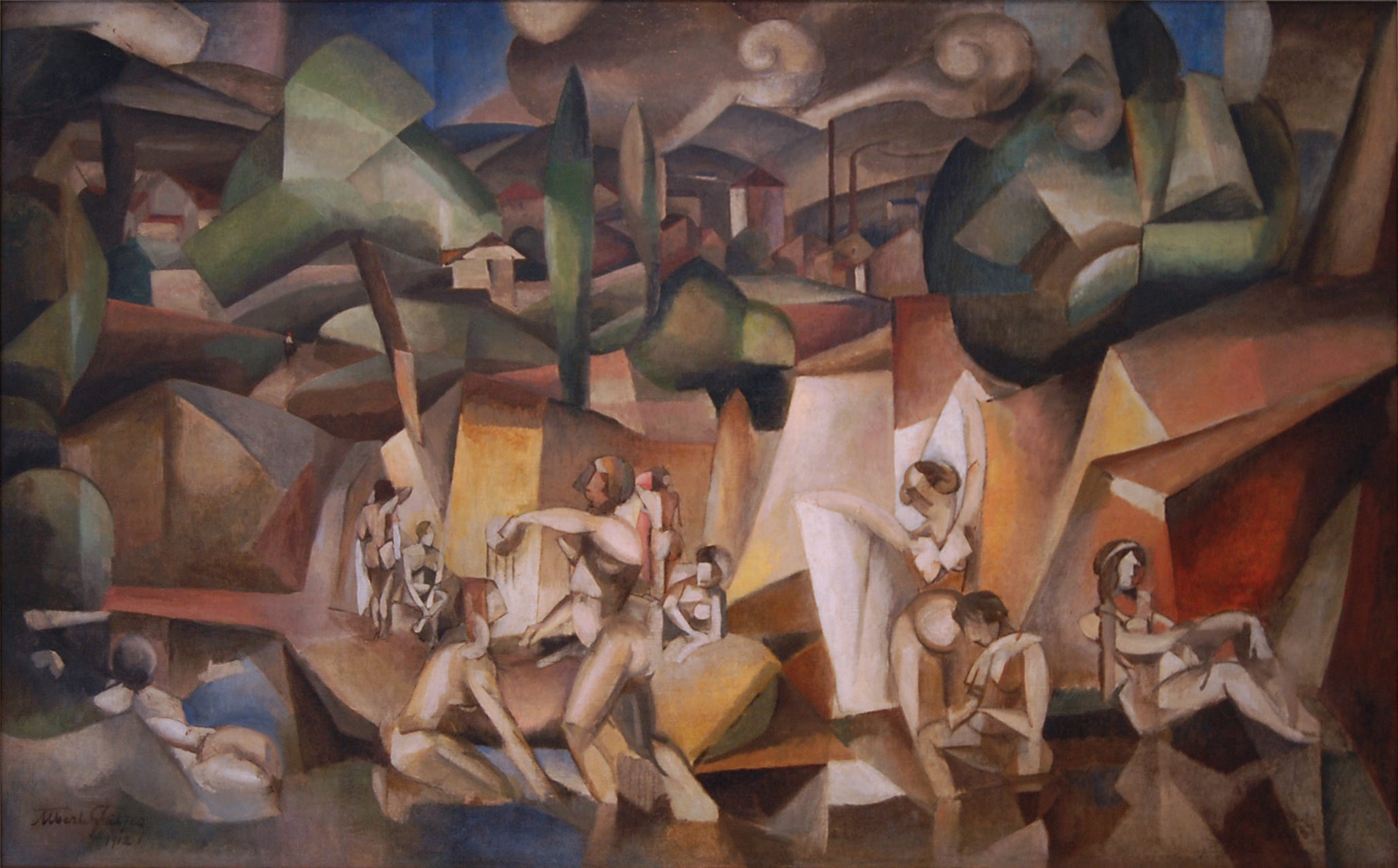
The subject of Mr. A. J. Eddy’s book, “Cubists and Post-Impressionism”1 (Grant Richards, 20s.2), is so full of matter that I find a column short enough for the barest examination of the facts. The general theme is, all significant painters are impressionists and some are cubimpressionists. The title suggests an ordered development of the theories and practices of cubists and post-impressionists. This we do not get. What we get is a very large number of extracts with comments thereon. The author refers, somewhere, to his book as “an offhand comment upon what is now going on in the world of art.” The extracts are mostly taken from the verbal and written utterances of leading extremists in painting. They are classified into Pre- and Post-Impressionist, Fauve,3 Cubist, Futurist, and other groups, for the purpose. Such painters, it seems, have the bad habit of chattering about definitions and theories. They ignore the fact that these things are all very well in their place, but attempts by painters to make a verbal living and reputation out of them are wildly ridiculous. Especially when the painted theories of a certain school do not agree with the written ones. We know, as Mr. Eddy reminds us, that the Italian Futurist painters believe that all the realistic details within a given area should be crammed into a picture, while the Futurist poet believes in the use of the fewest and most indispensable words run on the famous non-stop system. Under the circumstances painters should be seen not heard. To the critic the kind of partnership embodied in Mr. Eddy’s book is like enough to afford irritation. He is compelled to disentangle the author’s definitions and theories from the painter’s, and he is never sure that he is making a precise and correct division. Furthermore, he is compelled to meet the real difficulty residing in Mr. Eddy’s statement that:
Every department of human activity… speedily develops its own jargon and the tendency is for the jargon to become denser and denser and so more and more obscure its subject.4
As anyone may see for himself in the following explanation of Duchamp’s “Nude Descending the Stairs,” quoted by Mr. Eddy.5 “If you paint a girl coming downstairs, on any one step you will not show her moving. If you paint a girl on every step, like Burne-Jones with the “Golden Stair,” you have a crowd and still no movement.6 But if you get the forms down to simplest and most essential, just swaying shoulders and hip and knee, bent head and springy sole—and then show them on every step and between all the steps, passing and always passing one into the next, you give the sense of movement.”
Which is one way of making a mouthful of the trifle (verbally speaking) that the painter is seeking to make an abstraction of the individualising features of a movement experienced by him in a moment of time. In this trifle resides the only possible theory and practice of art. The painter has experienced an art-movement, he has assimilated what he was able according to his motional capacity, and in turn provided that which others might assimilate according to their motional capacity.7 Or, the theory and practice may be put in the words of the Russian painter whom Mr. Eddy quotes as saying that he likes “Kandinsky's Improvisations,” because in them the painter “has succeeded in conveying to me his own emotions.” One can believe it on turning to the charming examples of Kandinsky’s colour and design included with the twenty-three admirable colour reproductions in this book. Again, the theory and practice have been visited by the Italian Futurists. To them, “all that is within the vision, actual or imagined, of painter or sculptor, is a part of the picture or bust.” Otherwise, a synthesis of many realistic details, seen in an instant of time, is sought.
Mr. Eddy comments on the various theories with perfect fairness, and naturally he gets in a word for his own definitions. “Art,” says Mr. Eddy, “is delight in thought and symbol,” and the proper method of art-production is “first to see, then to dream and then on the morrow to paint.” He is describing Miller’s method and adds, “this is the method of all the very great art the world has ever known.”8 If so, then there has not been much “great art” about since Cézanne spent laborious years digging cube roots, “spheres and cones and cylinders” out of nature instead of flashing revelations out of himself. And one may reasonably assume that Van Gogh’s attempt to melt a world of solids like wax in the fire of his intensity was a humbugging affair.
Mr. Eddy falls a victim by the wayside of classification. Picasso is not a cubist, but an essentialist. Gleizes and Metzinger are not cubists, but fakers.9 Fergusson is not a fauve, but a rhythmist.10 For the rest, Mr. Eddy’s book is stimulating. It enables the reader to grasp some of the eternal qualities of art expressed by revolutionaries, Cubimpressionist and after.
Dissident Muse Journal is the blog of Dissident Muse, a publishing and exhibition project by Franklin Einspruch. Content at DMJ is free, but paid subscribers keep it coming. Please consider becoming one yourself, and thank you for reading.
Our current title in the Asynchronous Studio Book Club is Art in America 1945-1970: Writings from the Age of Abstract Expressionism, Pop Art, and Minimalism, edited by Jed Perl. For more information, see the ASBC homepage.
The next exhibition in the Dissident Museum is Suddenly, A Tree Appeared: Three Comics Artists Look at the Landscape.
On Saturday, March 7, 2026, I will present on The Socialist Book of the Dead at Liberty Forum.
Twenty shillings.
Spelled Fauvre in the original for some reason.
In the original, the blockquote included the following paragraph, which is obviously wrong, as it discusses Eddy.
This is, of course, Nude Descending a Staircase by Marcel Duchamp, 1912.
This is The Golden Stairs by Edward Burne-Jones.
Motional, sic.
Kenneth Miller (1876-1952), American painter.
Albert Gleizes (1881-1953) and Jean Metzinger (1883-1956), French painters who authored On Cubism, available as a PDF here.
John Duncan Fergusson (1874-1961), British painter. Again, I corrected fauvre.
Oh sure, cube-pressionist this & that, but nobody ever talks about the impubists.