
Picking Reds
Introducing The Socialist Book of the Dead.

On Wednesday, I’m traveling to the American Institute for Economic Research for a short-term fellowship to begin work on a history of socialist failures in graphic novel form. The title is The Socialist Book of the Dead. Inspired by serialized creative works that appeared in The Egoist, which I haven’t discussed but which I’ve been noting as I excerpt the magazine’s art writings, I will post installments of The Socialist Book of the Dead here at Dissident Muse Journal as I create them, alongside process drawings and working notes. (Serialized works that appeared in The Egoist include Joyce’s A Portrait of the Artist as a Young Man.) Upon completion, it will appear in print.
It’s an interesting time to start the project. New York City has a new socialist mayor. At his inaugural address, he promised, “We will replace the frigidity of rugged individualism with the warmth of collectivism.” Someone once said that fascism envisions the state as a powerful father, while socialism envisions the state as a nurturing mother. Zohran Mamdani’s New York City purports to gather you into the warmth of her bosom. Should you hunger, you will need only suckle.
I have a theory about the much-discussed cause for the enduring popularity of socialism, maintained despite its theoretical failure established during Karl Marx’s lifetime, and its empirical failure demonstrated at the cost of hundreds of millions of lives since the late 19th century. It is, in a word, puerility. The sense of justice that you developed by the time you were six years old is basically correct. It’s bad that people suffer. It’s good to share. It’s unfair that some people have easy lives and others have hard lives. If someone needs help, you should help them. Everyone is essentially the same. You should be kind.
There is durable truth in all this. We keep the true nature of the world from children, with good reason, to let this childlike view survive for a while. But what is forgivably childlike in early age becomes naivety in adulthood. Suffering is a complex existential problem. Sharing can only succeed within social limits, while considering available resources. What is fair and deserved in this world is unknowable. You cannot and should not help everyone who needs it. We have core humanity in common, but we manifest individually, with wildly differing traits and abilities. In general, you should be kind, but there are exceptions, and the implementation matters.
Socialism is economic and political puerility. A grown-up does not long for the warmth of collectivism any more than he longs to be reunited with his mother’s body. The idea strikes him as revolting.
The adult recognizes the truth in what Thomas Sowell once said: “There are no solutions. There are only trade-offs.” Not so with socialism. It is driven by anger that the world does not conform to a child’s idea of justice. When an adult doesn’t get what he wants, he earns it if he can, and accepts the loss if he cannot. The child throws a tantrum. The reliance of socialism on the mockery of competing propositions goes all the way back to Marx himself.1
The child lives in his imagination. He can pretend whole worlds into existence. A thing is this way or that because he declares it so. “Private property including and kind of ESPECIALLY homeownership is a weapon of white supremacy masquerading as ‘wealth building’ public policy,” said the newly appointed head of the New York City Mayor’s Office to Protect Tenants. This is mainly a problem of political progressives, but not exclusively. “Please be informed,” announced Donald Trump recently on Truth Social, “that we will no longer let the American Public be ‘ripped off’ by Credit Card Companies that are charging Interest Rates of 20 to 30%, and even more, which festered unimpeded during the Sleepy Joe Biden Administration.” Economically, the statements are equivalent, displacing blame for market forces on easy political targets. Trump’s plans to cap interest rates make no more economic sense than Mamdani’s plans to cap rents. There are no arguments you can make against minimum wage laws that you can’t also make against tariffs.
The Socialist Book of the Dead will cover historical socialism, not socialistic interventions like these contemporary examples. But the contemporary examples demonstrate why the historical examples remain salient.
The real world has a nature. It resists, and your reaction to that resistance says much about you. “This is the stock response among socialists when confronted with the failure of their schemes: counterrevolutionary elements are to blame.” So observed James Piereson in his recent dispatch for The New Criterion, “Socialism is a hate crime.” Socialists disdain ownership, including the ownership of responsibility.
People perpetrate galling injustices, including in capitalist systems. But solutions to those injustices that don’t accord with the nature of the world are doomed to failure. This needs to be repeated so long as people are prepared to sacrifice themselves and each other for the sake of destructive, even lethal, ideological visions.
Here’s the voice of hard-won experience: The first 80% of any creative project is preparation. The next 240% is execution.
Something about creative work causes the scope of any project to explode beyond initial schedule, cost, and labor estimates, every single time. I may be especially bad at the estimates. But there may also be something unique about creative work in that the artist must reveal the project in the act of making it. Part of the effort is determining what the project isn’t. Sometimes you have to bring aspects of it into existence so you can reject them. Technique is what you put in. Art is what you leave out.
It can be helpful, I have found, to establish constraints at the beginning. The Socialist Book of the Dead will appear in print in black and spot red, naturally. But which spot red?
My preferred LLM suggested four possibilities, and at my request, produced this chart.
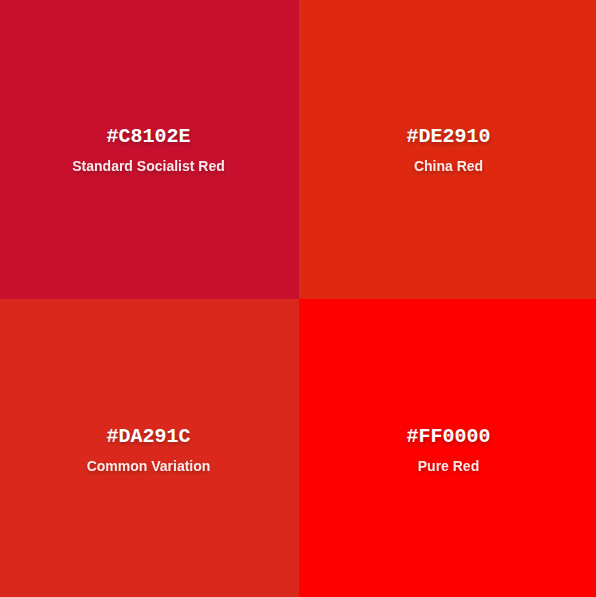
“The most historically accurate would probably be #C8102E,” said Claude, “which captures that classic bright red of Soviet banners and traditional socialist imagery—vibrant but not quite as intense as pure digital red.” DE minus DA in the red channel is 4, and 1C minus 10 in the blue channel is C (obviously), so the difference between China Red and Common Variation is pretty slight, a little less red and a little more blue, comparing the latter to the former. Standard Socialist Red compared to China Red is less red by 16, less green by 19, and more blue by 1E, and is surprisingly cool.2
Common Variation is a pretty good compromise between Standard Socialist Red and China Red. (Pure Red is disqualified as a matter of taste.) I asked Claude what is the equivalent Pantone spot.
Pantone 485 C is almost exactly
#DA291C.It’s one of the most widely-used spot reds—bright, vibrant, but with enough depth to avoid looking “cheap red.” It’s the red used by Coca-Cola, many university brands, and countless other applications.
Pantone 485 C specs: Hex:
#DA291C(literally your target!) CMYK breakdown: C:0 M:91 Y:87 K:15This is actually a perfect choice because: 1. It’s spot-on (pun intended) for your color; 2. It’s extremely common, so printers stock it; 3. It’s cost-effective because of its popularity; 4. It has that classic “socialist poster red” quality without being too orange or too burgundy.3
So specify Pantone 485 C for your print job and you’ll get that nice middle-ground between China Red and the deeper socialist red.
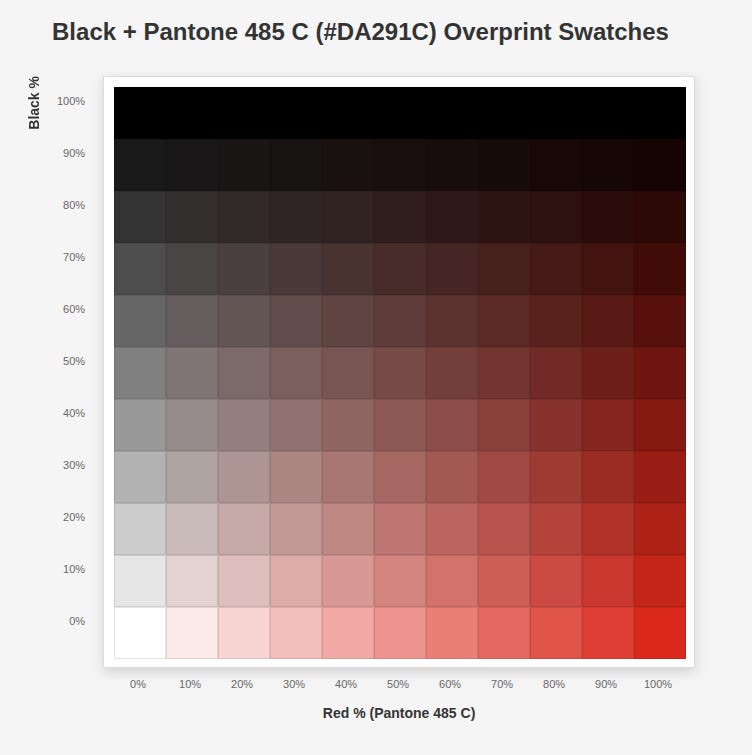
That checks out. It will work as roses; it will work as blood. I then asked Claude to make me a swatch chart.
For the sake of thoroughness, I asked Claude to make the same chart with Standard Socialist Red. As I anticipated, this is too rosy and not bloody enough.
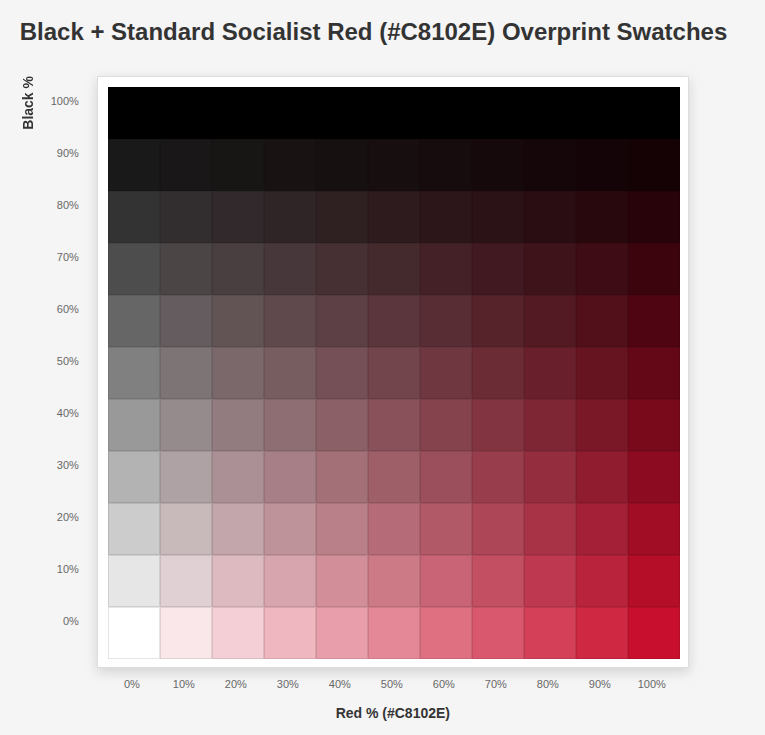
Tony Janello, one of my teachers at RISD, pointed out that when you mix white and blue, you get light blue, but when you mix white and red, you get pink, and pink is not light red. It’s an entirely different color. And 60% black + 50% red, even with Commie Common Variation Red above, is effectively purple. So this is a pretty big palette, considering the constraints.
Onward, to Massachusetts and several hundred other decisions.
Dissident Muse Journal is the blog of Dissident Muse, a publishing and exhibition project by Franklin Einspruch. Content at DMJ is free, but paid subscribers keep it coming. Please consider becoming one yourself, and thank you for reading.
Our next title in the Asynchronous Studio Book Club is Confessions of an Old Jewish Painter by R.B. Kitaj. For more information, see the ASBC homepage.
The current exhibition in the Dissident Museum is David Curcio: The Point of the Needle.
See The German Ideology, 1946.
Base 16, of course. (As the old joke says, there are 10 kinds of people in the world: those who understand binary and those who don’t.) Remember that green is a primary color in RGB, and combines with red to make yellow, thus increasing warmth, not cooling like it will on the RYB palette. The named HTML color Orange is #FFA500. That’s a lot of green.
“Pun intended.” It makes puns. It has intentions.
Looking forward to it...
This little paragraph though, it's a real gem on its own!
"Something about creative work causes the scope of any project to explode beyond initial schedule, cost, and labor estimates, every single time. I may be especially bad at the estimates. But there may also be something unique about creative work in that the artist must reveal the project in the act of making it. Part of the effort is determining what the project isn’t. Sometimes you have to bring aspects of it into existence so you can reject them. Technique is what you put in. Art is what you leave out."
I may just need to print that out, or better yet: include it in future cost estimates with customers...
Yes, Franklin, an awful lot of people need to grow up, and preferably get a real life.