
Inherently Human
John Cournos for The Egoist, 1915.

[I’ve become interested in The Egoist, which published from 1914 to 1919 in London. It began as a women’s rights magazine, but transformed into a leading journal of English modernism with sympathies for anarchism and libertarianism. Digitized issues are available from the Modernist Journals Project. I am presenting a selection of essays from the magazine relevant to visual art or of note for some other reason, to be anthologized by Dissident Muse. This is the tag for the series.
This is the posthumous appreciation of Henri Gaudier-Brzeska by John Cournos promised by editor Harriet Shaw Weaver in the previous issue of The Egoist. It appeared in Vol. 2, No. 9 (September 1, 2015). Footnote is mine.—FE.]
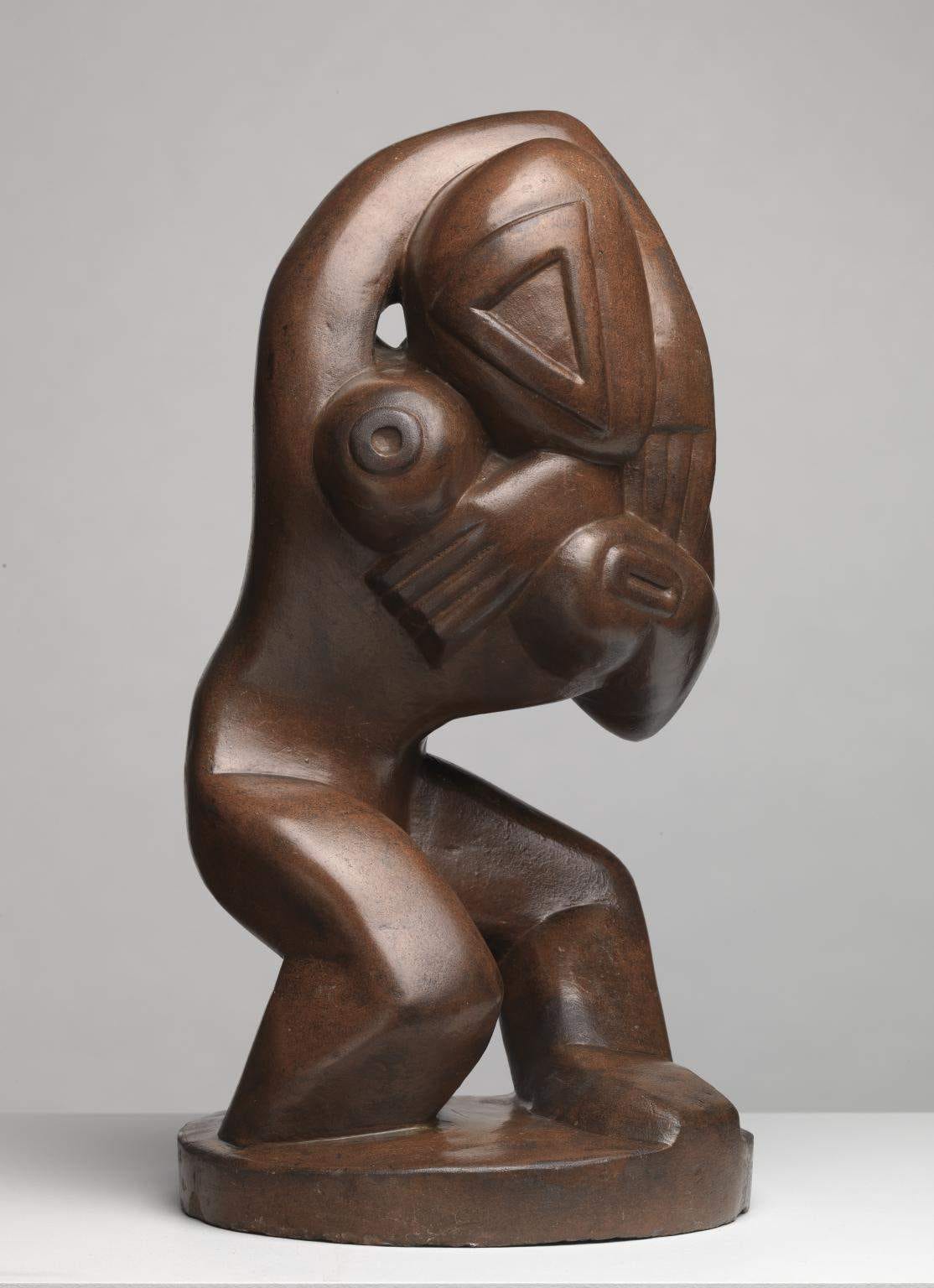
Gaudier-Brzeska’s career is interesting not only because it illustrates the difficulties which beset the path of the modern artist, groping to extricate his personality from the existing confusion of influences and movements, but also because, in Gaudier-Brzeska's case, this groping had been a natural evolutionary process bridging him over from old ideas to new.
His starting point was Rodin. That is to say, he began by making careful studies of life, which he sought primarily to endow with the quality of expression, without special regard to integral design. At the same time he exercised the Rodinesque power of anecdote with distinction.
Though character persisted in his next development, the individuality of the person remained photographic in rendering; the method itself, evolved from Brzeska's comparatively simplified forms of Rodin, was now chiefly concerned with the constructive power of masses and planes.
It was inevitable that he should break completely with Rodin. As he tended towards a greater and still a greater abstraction of form, the conviction grew upon him that Rodin, despite his undeniable genius, represented a force and a development within the academy; that he, in fact, was a giant who had carried the academical to its utmost limits.
Coincidently, there came the realization that to produce great works of stone one must think in terms of stone, that between an artist's ideas and an artist's materials there should be an intense sympathy, that for a sculptor there is integral beauty to start with in mere hardness and in simple masses, and that the hewing out of a thing carries with it greater suggestion of fundamental power than one ever can hope to obtain from modelling in a softish material like clay. And so henceforth Brzeska began to work directly in stone. Among the first products of this direct method were several small alabaster figures in which the masses were fuller and more significant than in his earlier work. These were somewhat influenced by Maillol and the Egyptians.
Gradually Gaudier-Brzeska arrived at the conclusion that round forms, no less than cubic forms, have the tendency to become insipid by repetition, and the recognition of this truth led him inevitably to evolve his later method. More his own than any of his previous methods, its chief aim was to achieve larger solidity of construction; it combined all forms in order to bring greater stress on integral design, beautiful in itself. Fundamentally, this method was completely opposed to that from which Gaudier-Brzeska started, because his forms were concerned no longer with imitation of life, but embodied all the qualities that have been labelled, in terms purely relative, as “caricature,” and “grotesque,” and “ugly,” qualities not to be repudiated or despised, inasmuch as they are inherently human, present in the art of all primitive peoples, and dependent upon intensity of vision.
This intense vision differs fundamentally from the vision of the Futurists—who represent the counter-current of modern art—in that it does not desire to harness the present moment merely, but aims rather to disentangle from the complex modern psychology and to capture that quality which is eternal, which concerns itself with the very meaning of life, which in essence is always the same, without regard to culture or machinery. This need not imply, argued Gaudier-Brzeska, that one need discard mechanics or modern science, but it merely proved that these belong to a distinct field and have nothing directly to do with art. Art, however, can restore to people the instinct which they have lost, and modern culture may assume the task of reinforcing this instinct with reason.
This intense vision again differs from the vision of the Futurists in that it aims at a certain serenity rather than at restlessness. This must not be taken to mean that it is concerned with merely presenting things and shapes at rest. Its problem is the expression of latent movement, and it considers the violent movement of the Futurists, despite its fascination, as something superficial, reflecting outward appearances and not the soul of things. And Gaudier-Brzeska offered an illustration to explain his meaning. Consider, he said, a motor-car. It is in itself an organized body with an expression of its own regardless of the speed at which it goes. Similarly, action as represented in the work of the Futurists is not the source of life, but its result. Sculpture should be an expression of the inner being. Thus, any object monumental and architectural in itself can only suggest movement. It should always be an interpretation, never a representation. At best Futurism is Impressionism carried to the most absurd limit, whereas art should be creation, having only an inner, subtle relation to life. Outwardly art and life are two distinct things.
It is the spirit of life, not life itself in all its petty detail, that Gaudier-Brzeska sought to embody in his sculpture. Thus, in the “Dancer,” which is of his latest period, he tried to realize the idea of the dance, and not the individual.1 In this statue he simplified and intensified the design for its own sake and not for the sake of expression; just as the early sculptors, tribal and primitive, did the same for the sake of their religion, and had symbols to express dancing and superstitions and all the rest of their customs and rites.
This integrity of design, which Brzeska thought so essential to a work of art, is not against the spirit of our age. Indeed, said the sculptor, strength being a dominant factor of such an art, it is much more reasonable to account for its existence nowadays than that of an art imitating Greek grace and prettiness. These are contrary to our age, an age marked for its cruelty, its machinery, its indifference, its pitiless attitude, its absence of sentimentality. The Greek craftsman in stone did his work well, but in his search for perfection, in his desire for finer finish, in his pursuit of naturalistic detail and charm, his craft got the better of him, and he sacrificed one great truth for many small ones. Few will deny Gaudier-Brzeska’s contention that his “Dancer” would make a fitter decoration for a modern machinery hall than would a graceful Greek statue; it is more difficult, however, to be sanguine about his idea that modern sculpture is the presaging of a new architecture, equally ruthless, integral, and stern. Because, after all, if commercialism and utility are at the root of our pitilessness, they are also the cause of the stifling of art. Not only would no owner of factories employ an architect with original ideas merely to please the age, but the arts of architecture and sculpture have unfortunately become divorced, partly through the intense individualism and specialization of our time. An art half utilitarian, like architecture, attains universality and unity through disciples; and the prevailing theory of individualism precludes disciples. Many “masters” of to-day are really disciples in soul. They imitate weakly the real masters, and deny them at the same time. It is, therefore, inexpressibly sad when a man like Brzeska is lost to us; for Brzeska had in him the makings of a master.
Dissident Muse Journal is the blog of Dissident Muse, a publishing and exhibition project by Franklin Einspruch. Content at DMJ is free, but paid subscribers keep it coming. Please consider becoming one yourself, and thank you for reading.
Our next title in the Asynchronous Studio Book Club is Art in America 1945-1970: Writings from the Age of Abstract Expressionism, Pop Art, and Minimalism, edited by Jed Perl. For more information, see the ASBC homepage.
The next exhibition in the Dissident Museum is Suddenly, A Tree Appeared: Three Comics Artists Look at the Landscape.
On Friday, March 6, 2026, I will present on The Socialist Book of the Dead at Liberty Forum. Time TBA (but tentatively, morning).