
After the War
Richard Aldington for The Egoist, 1914.

[I’ve become interested in The Egoist, which published from 1914 to 1919 in London. It began as a women’s rights magazine, but transformed into a leading journal of English modernism with sympathies for anarchism and libertarianism. Digitized issues are available from the Modernist Journals Project. I am presenting a selection of essays from the magazine relevant to visual art or of note for some other reason, to be anthologized by Dissident Muse. This is the tag for the series.
The following essay by Richard Aldington appeared as “Notes on the Present Situation” in the Vol. 1, No. 17 issue, September 1, 1914. Alas, even though The Egoist continued until Vol. 6, No. 5, we’re approaching the end of this series. England entered the Great War on August 4. Several names mentioned already—Lewis, Gaudier-Brzeska, Aldington, and others—enlisted. Aldington could continue to write poems from the front, but Gaudier-Brzeska could hardly sculpt there. The notion that the modern artist might find inspiration in the forms of industrialization (“all revolutionary painting today has in common the rigid reflections of steel,” proclaimed Lewis) suddenly seemed gruesome in light of the new mechanized warfare. Imagism hung on as a literary movement, largely because it was possible to write Imagist war poetry. But the hoped-for metallic utopia envisioned by Vorticism looked ever more like balderdash as the war dragged on.
Visual art coverage appeared with decreasing frequency in The Egoist from this issue forward, and the magazine converted from a fortnightly to a monthly with Volume 2. The following essay by Aldington exemplifies his tendency to superciliousness—“this little excursion of the Kaiser” ended up killing 40 million people, not that he would have known at the time; he emerged from the carnage a changed man. But it feels necessary to include it because it acknowledges the beginning of the conflict. Footnotes are mine.—FE]
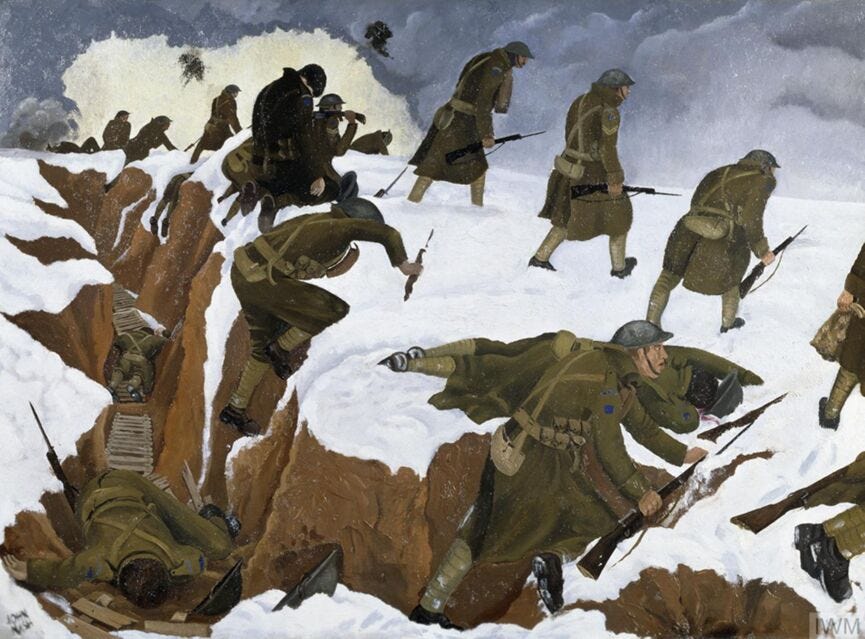
There seems now to be only one subject exercising everyone’s mental and physical activities—the War. The curious effects of this notable calamity on individuals could best be noted by a writer of the timbre of de Maupassant. Its effects on crowds might attract M. Romains or some other one of the Unanimistes.1 (It is odd to think that these poets are probably in or near the fighting line.) The state of mind of the individual in a case like the present is undoubtedly influenced by the mob psychology.
Since this is so, what of the arts? For the arts are the expression of the individual—this in spite of the professors, of the public, which enjoys the flattery of supposing itself the creator of art, and of certain reactionary artists here and abroad. A great war like the present tends towards the creation of type as opposed to the creation of individuals. Patriotism is obviously a social virtue. A month ago Englishmen hated each other as individuals. Now, at the social touch, they are all men and brothers, hating intangible “Germans” whom they have never seen. This kind of social feeling does not produce art—for proof of this consult the war poems in the papers. The impulse is too vague, too general; the impulse of art is always clear and particular.
The truth is that we are all too much engulfed in the “group psychology” to be artists. All our energy goes in outside effort, in anxieties and hopes, in combating the general fidgetiness. Somewhere about there may be a modern Gautier, who, after the war, will emerge from his study, wonder what the cheering is about and say proudly “Moi, j’ai fait émaux et camées.”2
“After the war.” Ah, things may be different then. I am enormously tempted to theorise on the possibilities of the arts after the war. By all the rules we should have a popular art of great sentimentality and among the artists, a movement akin to that of the symbolist school in France. Fortunately the gods have withheld the gift of prophecy from all men, so none of us can tell what the art of 1925 will be like. Possibly there will be no art at all—very probably, I should think. Anyway, lots of the cranky stuff of the last few years will be swept away.
I see at least two good results in this war—two good results I mean from a somewhat narrow and personal standpoint. First of all, numbers of the hangers-on of the arts, those dirty little vultures which hung around looking out merely for carrion, will be done away with. Since the arts now offer no effective remuneration whatever they will be practised only by real artists. (On the other hand the artists will be the first to starve. Sic semper.3) The other good result is this. In a little while we shall be able to start work again, and since we shall do it purely for its own sake—as I hope we always have—it will at least be sincere. The most terrifying symptom of modern art is its complete insincerity. In London I know of only two artists who are not either charlatans, posers or “vaniteux.”4
But how completely demodé5 the posers will be after the war! If anything written in this century before the war is remembered ten years after it the author may almost consider himself a great man, at least a superior intelligence.
Think of the appalling number of tedious periodicals and books which will be produced during the war and after—all on the same subject! Have you reflected what a prodigious amount of mental lassitude and boredom will result from this little excursion of the Kaiser? Reflect! Marinetti6 is probably at the front—sacro Christo! we shall have more poems! And far, far worse—for Marinetti is an artist—we shall have endless sentimental novels, novelettes, stories, pictures and patriotic music, all warlike and all damned.
Before the war there was a great deal of talk of dynamism. While it lasted I was never completely easy. It sounded all right, but somehow it never worked. It seems to me that the finest moments of my life and in my writing have never been brutally “dynamic,” however “modern.” “Children of our age” are we? No, children of our class. Certain superficial difference put aside, a poet or painter of to-day would feel more at home in the presence of one of his kind belonging to another century than with a bargeman or with a cavalry colonel of to-day.
That opinion is now a heresy because it was once orthodox. I believe I herald its return to orthodoxy. That is one of the curious anomalies of to-day. One must be at all costs heterodox and the difficulty is to know what is orthodox. Perhaps we shall know “after the war.”
“After the war”—noble phrase! Better than the Spaniard’s “To-morrow.” “After the war “ we will pay our bills, enjoy universal peace, see the beginning of a new era, accomplish our dreams, be faithful to our wives. Alas, the war is the moratorium of Europe’s good resolutions. In these days there is one place which is free from the almost universal war scare. That is the British Museum Library. It may be that the man next to one is studying tactics and the woman two seats off reading manuals of nursing and military sanitation. These little incidents do not disturb the perfect atmosphere of scholasticism. During the last few days I have read the most extraordinarily “high-brow” stuff. Things like “Les cents Nouvelles,” du Roy Louys and Marguerite of Navarre’s “Heptameron,” Godeschalcus the mediaeval séquaire writer, Firenzuola, who wrote of the beauty of women, and French translations of Greek novelists like Achilles Tatius, Longus and Xenophon the Ephesian. I had designed inflicting some of the results of my studies on readers of The Egoist. I spared them less from solicitude than from the mental indolence caused by the war.7
I regret to see in to-day’s issue of the “New Weekly” that this periodical may have to come to an end. I may say that I regret the “New Weekly’s” possible decease extremely, because they occasionally allowed me to thunder through their pages. In an article in the present number Mr. Arnold Palmer says that though you can read Cervantes or Stendhal with guns booming under your nose, you can’t read a “merely graceful, agreeable writer like Henri de Régnier.” Curious coincidence; I am reading “Romaine Mirmault”—Régnier’s last novel —with as much satisfaction as I ever read anything.
They tell me that although Régnier is the greatest stylist living he is not a great man because his work has no “significance.” Ah, the villain word! Does it make any difference whether the “significance” of a book is simply that you get a complete impression of a French village in summer and of a young man kissing his cousin or whether the book’s “significance” is cosmic and philosophically overwhelming? All these things are so little that the greatest is not much bigger than the smallest. The great war is not much bigger than the fight of two tom-cats.
Notice that this is a war of the bourgeois, rather rare in history. The aristocracy of all the nations engaged have no real hostility towards each other; the cosmopolitanism of practically all artists and scientists rules them out; the people—except in France—have no particular feeling against the other races. I mean they don’t hate them as our peasants hated the French in 1814 or as the French have hated the Prussians since Sedan. Only the bourgeois are left. They, poor souls, have been so terrified by the sounding rhetoric of the political and military writers in the more expensive magazines that they have hurled themselves at each other’s throats from sheer funk. It is Aguecheek and Cesario over again, egged on by the Sir Toby Belch of the press.8
The press, by the by, has at last got someone to sit on its head. What the ha’pennies call “Lord Kitchener’s iron censorship” is a great joy to me. Think of the sensation mongers waiting with flaring headlines for the word of command and not daring to publish beforehand. If only Lord Kitchener would start a bureau for the proper supervision of literary writings—writers to The Egoist would of course hold an important position in this affair, c’est bien entendu.9
Just now—at the beginning of this—I said how queer it was to think of Romains, Vildrac and people like that being in the French Army. I have just glanced through the Poètes d’Aujourd’hui and I find that in the first volume thirteen of the poets are liable for service—this includes Jammes, Paul Fort and Pierre Louys. Camille Mauclair and Vielé-Griffin are also liable; so is Henri de Régnier, unless members of the Academy are excused.
While France sends poets, painters and probably philosophers to fight, England cannot even call up her cricket and football teams. I’m damned if I’ll be killed while there are five hundred professional football teams, with their attendant ministers, unslain.
Dissident Muse Journal is the blog of Dissident Muse, a publishing and exhibition project by Franklin Einspruch. Content at DMJ is free, but paid subscribers keep it coming. Please consider becoming one yourself, and thank you for reading.
Our next title in the Asynchronous Studio Book Club is Confessions of an Old Jewish Painter by R.B. Kitaj. For more information, see the ASBC homepage.
The current exhibition in the Dissident Museum is David Curcio: The Point of the Needle.
Guy de Maupassant (1850-1893), French author. Unanism was a literary movement founded by French novelist Jules Romain (1885-1972).
“Me, I made enamels and cameos.” The reference is to Émaux et Camées, an 1852 poetry collection by Théophile Gautier.
“As always.”
The “vain.”
“Unfashionable.”
Filippo Tommaso Marinetti (1876-1944), Italian founder of Futurism.
I’m foregoing explanations of every single reference hereon. You get the idea.
Aldington is likening the press to Sir Toby of Twelfth Night, goading unwilling combatants into a duel.
Career military man Herbert Kitchener (1850-1916) was appointed Secretary of State for War, and imposed press controls on war reporting, to the chagrin of the tabloids. Aldington sardonically wishes that the controls would extend to literary publication, hinting that he’d be among the censors, naturally.