
Your Ethos Has Cancer
You should have an informed, responsible discussion about treatment options with your deity.

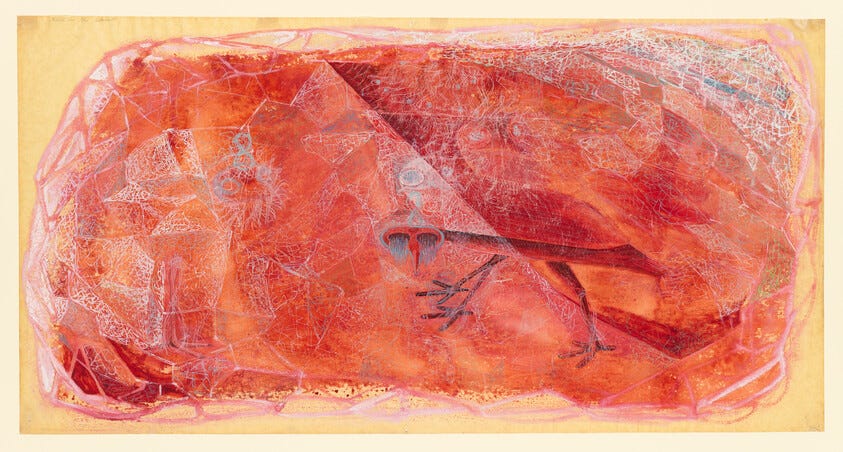
Suppose, God forbid, that your biopsy results came back and the news was bad. Would you pursue the recommended treatment, or take to vaguely admitting that you’re ill, going on with life as you’ve lived it, and letting yourself be eaten from the inside?
Douglas McLennan of ArtsJournal has begun to issue weekend summaries of the stories that appear in his newsletter over the course of the week. This sometimes amounts to interpreting Rorschach blots, but I’m not opposed to the exercise. Here was his missive from Saturday:
The Venice Biennale, one of the visual arts world’s most important events, opened Saturday in complete disarray. The EU pulled its funding. Earlier in the week the jury resigned over which countries should be eligible. The Golden Lion — the coveted grand prize — was scrapped for a people’s choice vote. The US pavilion sits nearly empty after the Trump administration declared it wanted work to “reflect and promote American values” (talk about your metaphors). Iran withdrew. Anish Kapoor said the US should be banned outright. Pussy Riot stormed the Russian pavilion in pink balaclavas. Artists went on strike. This is what happens when an institution of cultural authority can no longer agree on its own basic terms — who gets in, who decides, and what its prize actually means.
“Artists went on strike”? Why? “In protest over Israel’s continued participation,” as it happens.
Dries Verhoeven, the artist representing the Netherlands at this year’s event, said on Friday that he had shut his pavilion to show his “disgust” at the Biennale’s decision to allow Israel a platform given the “darkness” in Gaza.
So did artists associated with Belgium, Great Britain, France, Spain, Portugal, and other countries whose histories of colonialism are such that you would have to run Gaza Wars back-to-back for centuries to match the death tolls. France invaded Algeria in 1830 to get out of paying millions of francs owed to Jewish financiers in North Africa who had brokered loans from the Algerian regency. By 1875, French forces had killed 825,000 Algerians, more than Palestinians were killed in the Gaza War by a factor of eleven. Six months ago, Algeria passed a law declaring that French colonial rule there was a genocide. The idea that modern Jews owe modern Europeans moral accountability for the movements of history, either past or in the making, is deranged. I invite those who closed their Venice Biennale pavilions in performative umbrage about Israel to throw themselves into a picturesque canal.
You can click through McLennan’s article and discover the motivations for the strikes. But you can’t un-elide the the non-mention of the mob of keffiyeh-wearing protesters who forced the closure of the Israel pavilion, chanting “from the river to the sea,” which is an express call to slaughter all the Jews in Israel and disperse their nation. It has been such ever since the PLO began using it as a slogan in the late 1960s, and no one pretended otherwise until its contemporary evocation collided with a prior decade of progressive “antiracism.”
Back to McLennan:
…if cultural institutions — of course self-interested and self-promoting as ever — have diminished cultural authority in the broader culture, and critics and prizes have declined in influence as slightly more independent declarers of “quality” or standards, and if even notions of quality have transferred from evaluating the work itself to toting up the algorithmically-optimized attention and engagement that “content” generates, what’s the role of an arts institution or a creative field in a sorting environment built around algorithms, communities, and platforms they don’t operate? … [The Biennale is] an old cultural institution suffering an identity crisis caused by threats to its relevance. Most of the older sorting machines are losing relevance more quietly and perhaps it’s those that should worry us more.
We should worry about all of them. They have Stage Four cancer of the ethos. It won’t do to tiptoe around naming the symptoms of Jew-hatred and related political opportunism.
In 2020, Senator Tom Cotton of Arkansas suggested that Covid had been manufactured in a lab in Wuhan. The New York Times ran the article “Senator Tom Cotton Repeats Fringe Theory of Coronavirus Origins,” calling the suggestion a “conspiracy theory.” American intelligence organizations now assume that the explanation is true. As of this morning, the Times was standing behind reporting by Nicholas Kristof that the Israeli Defense Forces had trained dogs to rape Palestinian prisoners. Sourcing on the story is garbage. People professionally familiar with dogs have characterized the scenario as biologically and behaviorally unsound. In mixing reporting on founded allegations of prisoner abuse with balderdash, it is following a pattern exemplified by Arab-language propaganda about the Danish cartoon controversy, which reprinted cartoons published by the Jyllands-Posten with other, more inflammatory images that deceitful actors said the paper had published but did not. But the Times denies that Kristof’s reporting of a patent conspiracy theory is faulty, or that they published the story to get ahead of an analysis published by CNN on the same day documenting systematic rape and sexual mutilation by Hamas in the October 7 attacks.
Moral failures like this outweigh responsible reports at the paper even if they don’t outnumber them. And what’s going on at the New York Times is typical of our institutions. Biennale President Pietrangelo Buttafuoco has restated his opposition to censorship, but his principles are getting overrun by clowns like Verhoeven. Matthew Teitelbaum started his tenure at the MFA Boston by capitulating to the moral thugs associated with the Kimono Wednesdays protests and ended it by capitulating to the moral thugs associated with the Philip Guston cancellation. Saher Alghorra, who produced a photograph widely circulated as illustrating famine in Gaza, but in fact depicted a child severely underweight from a medical disorder—The New York Times, again, had to retract a claim that the mother said the child was healthy before the conflict—was just awarded a Pulitzer Prize for “his haunting, sensitive series showing the devastation and starvation in Gaza resulting from the war with Israel.” The Yale student who became the ugly icon for social justice in 2017 by screaming at Nicholas Christakis was subsequently granted the school’s Nakanishi Prize. Several major universities have surrendered hundreds of millions of dollars to the Department of Justice rather than endure investigations into the treatment of Jews on their campuses over the last three years. Boston University denied financial impropriety after Ibram Kendi turned $43 million into smoke; now he’s teaching at Howard and has a new book out.
Do these institutions often produce good news stories, publish useful scholarship, and reward worthy recipients? Of course. When you have cancer, do you consist entirely of cancer? Of course not. Cancer doesn’t kill by cellular majority, but by systemic malignancy.
At some point, our institutions—or an overriding cohort within them—decided to stop being mechanisms of discovery and start being mechanisms of control. They’re not passively “losing relevance,” they’re actively betraying their proper role in the world.
If I were a self-righteous midwit like Ibram Kendi or Adolf Hitler, I would take the analogical conceit of this essay to its rhetorical conclusion and demand an application of surgeries, amputations, and radiation beams on the illness in the ethoic body. But I’m in the ethoic body, along with everyone else. My worry is how to avoid becoming one of the cancer cells.
If I’m correct, the institution-as-control-mechanism is less interested in a particular politics than in resource extraction, modeled on the manner in which Charles X moved 34,000 troops into Sidi Ferruch rather than make good on debts owed to the Algerian Dey. This would be hard to prove, but my theory is that American politics is getting crazier as the debt-to-GDP ratio nears 100%, which it recently passed, and will become crazier still as it approaches 2. The line is more psychological than economic, but the threshold indicates that there’s decreasing wealth to be amassed via capitalism (that is, free markets), leaving opportunities only in the realm of corporatism (business opportunities made directly or indirectly possible by government schemes, such as the twenty-year effort to replace the Taliban with the Taliban in Afghanistan), philanthropy (see, among other projects, the Boston University Center for Antiracist Research), and public finance shenanigans (for instance, Albany’s recent $4 billion bailout of New York City). I’ll refer henceforth to this wide class of activities as “extractionism.” It’s the socioeconomic analogue of cancer.
Extractionism necessitates the elevation of real problems into manufactured emergencies that require such interventions. But the interventions must never solve the emergencies. Examples are too many to name. Educational and education-related outcomes have deteriorated as long as the Department of Education has existed. DEI workplace trainings are known to worsen racial relations. Contemporary nuclear power technology could massively reduce carbon emissions, but activists pursue renewables at enormous expense to the environment. California spent $24 billion on the homeless from 2019 to 2024, and in that time their numbers increased by 30,000. Conservative causes can also be milked, but as conservatives become increasingly anti-war, the remaining big money is in progressive concerns. The key is not the progressivism, but the manipulability.
How easy am I to manipulate? I am manipulable to the extent that I can be convinced to hate anyone. People who hate Trump, or the woke, or Israel, or progressives, or racism, or Russia, or conservatives, or Mamdani—whatever—are just gears in the machinery of extractionism. Insist on seeing the humanity in all people, and in your small way, you are defeating the worst exploitation going on in the world. You can’t get a mob of Jews to surround a mosque in Brooklyn and shout genocidal slogans. But you can get anti-Israel activists to surround a synagogue in Brooklyn and shout genocidal slogans, so they become the sources of chaos that the extractionists need to draw attention away from the fact that unfunded federal liabilities in the United States are $344,000 per person and growing. Eventually anti-Zionism will start to look shabby just like “antiracism” started to look shabby in 2023, and the extractionists will have the next ego trip picked out for them. The keffiyehs will go in the closet next to the Black Lives Matter t-shirts and the pussy hats.
Pushing back on this requires first-principles political awareness, but not only that. There is a reason that so many advocates of universal love and forgiveness—Jesus, Akiva, al-Hallaj, Arjan, and many more—were martyred by the state. They were the least controllable humans ever to walk the planet. I would revive interest in such figures and their spiritual descendants, as used to be more common among artists—Hyman Bloom, Morris Graves, Bill Viola. Even a confirmed sybarite like Henry Miller figured out that the freedom he sought was existential. From “Creative Death,” collected in The Wisdom of the Heart:
In a way the artist is always acting against the time-destiny movement. He is always a-historical. He accepts Time absolutely, as Whitman says, in the sense that any way he rolls (with tail in mouth) is direction; in the sense that any moment, every moment, may be the all; for the artist there is nothing but the present, the eternal here and now, the expanding infinite moment which is flame and song. And when he succeeds in establishing this criterion of passionate experience (which is what Lawrence meant by “obeying the Holy Ghost”) then, and only then, is he asserting his humanness. Then only does he live out his pattern as Man. Obedient to every urge—without distinction of morality, ethics, law, custom, etc. He opens himself to all influences—everything nourishes him. Everything is gravy to him, including what he does not understand—particularly what he does not understand.
In these ever more dire circumstances, we people, we artists, must make a choice. We can either follow great beings to liberation, or follow The New York Times into hell.
Dissident Muse Journal is the blog of Dissident Muse, a publishing and exhibition project by Franklin Einspruch. Content at DMJ is free, but paid subscribers keep it coming. Please consider becoming one yourself, and thank you for reading.
Our current title in the Asynchronous Studio Book Club is Glittering Images: A Journey Through Art from Egypt to Star Wars by Camille Paglia. For more information, see the ASBC homepage.
The current exhibition in the Dissident Museum is Suddenly, A Tree Appeared: Marek Bennett, Greg Cook, Ansis Puriņš.
Dissident Muse Journal is publishing a serial comic, The Socialist Book of the Dead: A Graphic History of Collective Failure.
Curious how the spiritual impulse begins again to feel so radical. I appreciate your broadening perspective, dare I say forays toward wisdom.
As for the latest manifestation of New York Times perversity, it's simply acting according to its nature. Kristof, of course, was just the hired implement; the paper chose to run his piece and is fully responsible for its publication. I've heard Israel has threatened to sue the paper for defamation, which may well not be winnable in a New York City courtroom, but I hope Israel does it anyway.