
Thunderclap (4)
An Asynchronous Studio Book Club reading of Thunderclap: A Memoir of Art and Life and Sudden Death by Laura Cumming.

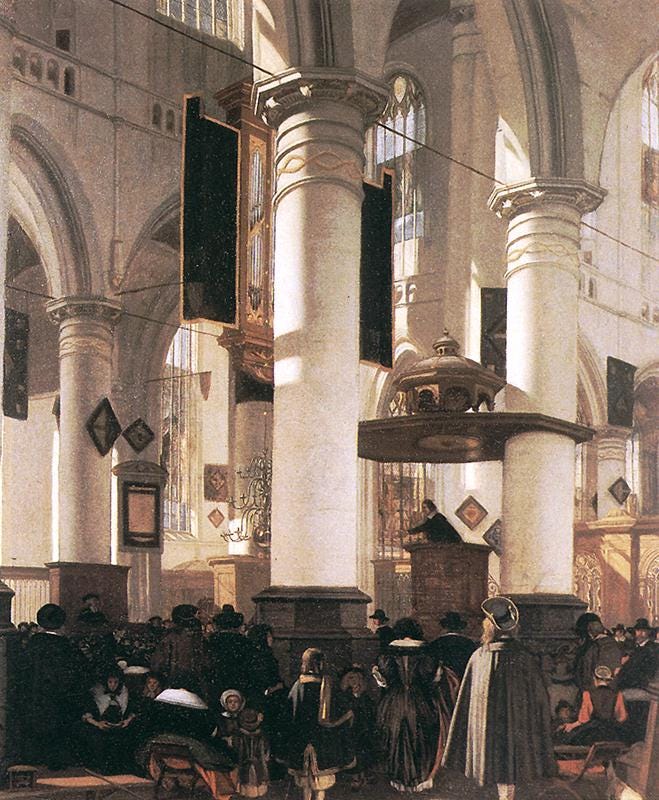
A brief note is all that’s necessary to conclude discussion of Thunderclap. Its structure of short chapters, alternating between biography and autobiography, proceeds through the end of the book. The detonation of a gunpowder magazine in 1654 claims Carel Fabritius along with much of Delft; cancer claims the author’s father. The understatement of the latter is a touch strange, but continuous with the tentative, pieced-together retelling of the life of Fabritius, handled personally but aware that it too can be thought of as happening four centuries ago, as one day it will be.
It was edifying to learn of the lives and careers of Dutch painters whose works otherwise blend into the amalgam of Dutch painters whom I can’t easily differentiate. Laura Cumming has thought more about Emanuel de Witte than any art critic working presently.
Here is a tourist in a red cloak making an extravagant gesture with his outstretched hand, showing off history to his heedless young wife who turns her attention, instead, to an urchin pleading for money. And here is a faithful greyhound, taken to visit the dead hero, behaving with perfect obedience. The black squares, in all that puritan whiteness, are like covered faces.
The windows are so clear you can see the exact shape of the buildings outside. A gentleman in a turban leans over the guard-rail, listening, as the whole story is told to him too. Gold sparkles here and there. The light is as bright as a spring day.
Among the final literary images is the possibility that Fabritius’s Goldfinch is shot through with particles of the explosion that took its painter’s life.
The Goldfinch had been X-rayed before. Curators had at that time noticed some small indentations in the surface. But from the scans it is possible to see, and therefore to know, far more. What they show is that the painting bears the traces of a blast, the minuscule indentations of hurtling matter, broken shards, hard pellets blown scattershot through the air, across the room, pocking its surface in an instant. And the further revelation of these scans is that the explosion registered in a surface that did not split or shatter because it was not dry. The Goldfinch was still wet, still drying, a work in progress like its maker, a living thing in the studio when Fabritius was dying.
Thus life and death interpenetrate, and any still slice taken from life, like a painting, show each of them in motion, and continuous with each other.
After returning to Jed Perl’s Art in America 1945-1970, the Asynchronous Studio Book Club will discuss Glittering Images: A Journey Through Art from Egypt to Star Wars by Camille Paglia over four weeks starting April 26, as scheduled. I’ll double up on the Art in America reading planned for last week and this on Sunday to make it happen.
Dissident Muse Journal is the blog of Dissident Muse, a publishing and exhibition project by Franklin Einspruch. Content at DMJ is free, but paid subscribers keep it coming. Please consider becoming one yourself, and thank you for reading.
Our current title in the Asynchronous Studio Book Club is Art in America 1945-1970: Writings from the Age of Abstract Expressionism, Pop Art, and Minimalism, edited by Jed Perl. For more information, see the ASBC homepage.
The next exhibition in the Dissident Museum is Suddenly, A Tree Appeared: Three Comics Artists Look at the Landscape.
The handling of light in that de Witte is practically the whole picture, and it's beautifully done.
As no doubt you realize, Franklin, most critics working currently either don't know de Witte or have no use for him, so they're quite unlikely to give any indication they've even heard of him.