
Thunderclap (3)
An Asynchronous Studio Book Club reading of Thunderclap: A Memoir of Art and Life and Sudden Death by Laura Cumming.

I just wrapped up a freelance gig that has required long hours in front of the computer, and made furthering them with more writing unattractive. I’ll spend this week catching up on book club reading, with something resembling regular programming returning the next.
Cummings detours into two cases of damaged sight, her daughter’s and that of Dr. Samuel Johnson. The former case is strangely told, as if she suddenly came down with a rare case of blue-yellow colorblindness that stumped the family and all but the best doctors. It turns out that she had taken a photograph of the sun with her phone camera and singed her retinas just so. You’d think that would have come up as a possible cause earlier.
The next section arrives without segue to discuss the long-held dismissal of Dutch painting as an art of materialism and moralism. I’ve written elsewhere about the inexcusable indifference with which some contemporary commentators have characterized the art of Europe. “Because this is a museum in a progressive metropolis in 2022,” I said of the renovated Greek and Roman galleries at the MFA Boston, “wall-labeling implicates the germane cultures in slave-mongering. It does likewise in the halls of Dutch and Netherlandish art, also newly renovated and scintillating in their own right, as well as in the entrance to the Art of the Americas addition. (To avoid mention of slavery, keep to the MFA’s exhibits of Egyptian art and that of the Islamic world. Note the irony.)”
But it’s important to remember how bad some of the original takes were as well.
Sir Joshua Reynolds, President of the Royal Academy, goes in pomp to Holland. He looks at Dutch art and tries to find something to admire. In Amsterdam, he comes across some paintings by Gerard ter Borch. ‘Two fine pictures of Terburgh: the white sattin remarkebly [sic ] well painted.’ But Ter Borch does it too often. ‘He seldom omitted to introduce a piece of white sattin in his pictures…’ Worse still are ‘dead swans by Weenieux, as fine as possible, I suppose,’ he sighs, ‘but we did not see less than twenty pictures of dead swans by this painter.’ Poor Reynolds, casting fruitlessly about for Dutch paintings to praise. ‘As their merit often consists in the truth of representation alone, whatever praise they deserve, whatever pleasure they give when under the eye, they make but a poor figure in description. It is to the eye only that the works of this school are addressed.’
This has been the general bias of foreign commentators pretty much since the seventeenth century, when the French art writer Roger de Piles excoriated the diet of vegetables, fish and dairy which he believed made the Dutch phlegmatic, sneering at these artists who ‘would toil with infinite patience on one, usually small, work at a time, generally depicting a base subject’.
This may have been a matter of overwhelm.
Art proliferated in the new Dutch Republic as nowhere else and as never before. Somewhere between 1.3 and 1.4 million paintings were produced by between 600 and 700 painters in not quite two decades at the mid-century, according to scholarly calculations; though other estimates run as high as 8 million.
But Cummings sees through it through sheer power of devotion to a single work at a time.
I think of a marvellous painting of these trivial comestibles by Clara Peeters: a breakfast roll newly torn from the morning batch, some hunks of Dutch cheese piled upon each other and topped with a dish of butter, the knife laid ready on the bare surface of the wooden table; exactly what we ate in our Dutch boarding house on that first holiday. Isn’t this the very definition of unnecessary art – a quick meal, rapidly eaten, a bore to clear away; why would anyone bother to paint breakfast? But the elements are so simple and joyous, the scene so modest yet exhilarating in its knowledge of the salty smoothness of the butter and the crisp crust of the roll, the relish of slicing that knife down through the ready cheese; a vision of common pleasures enduring through time. Peeters makes philosophy out of a poor man’s banquet.
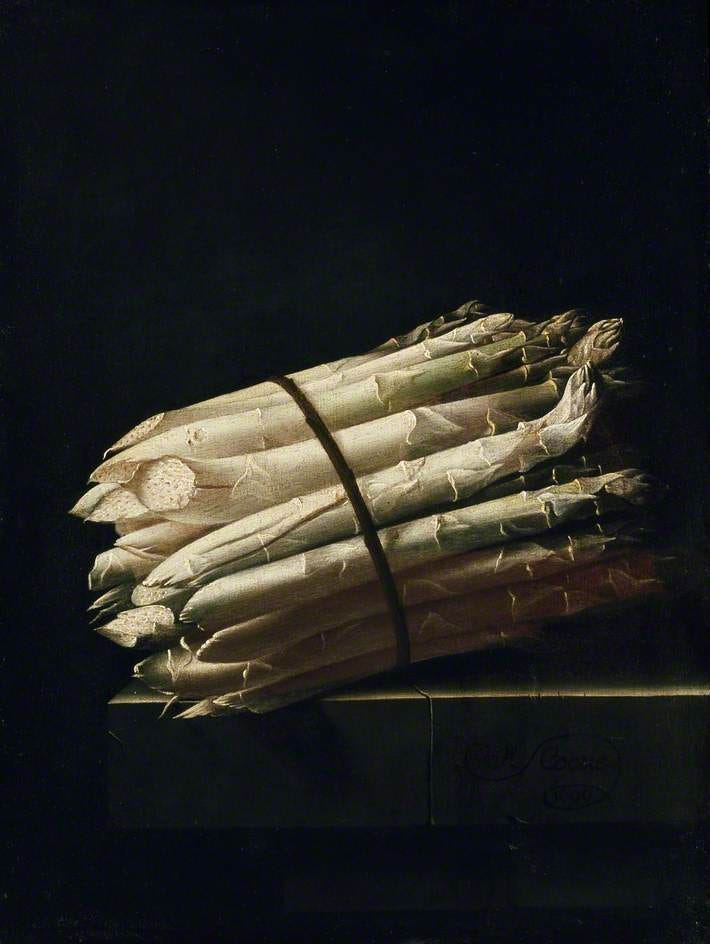
She once attended a packed lecture by Derrida. Her French wasn’t up to the task of comprehending it (arguably, no one else’s was either), but the institution in which it took place held a Coorte bunch of asparagus which led to a prolonged fascination with the painter.
I did not know how to be still, and I hardly do now, except perhaps in front of art. So my gratitude to artists is unending. And to me these paintings by Coorte are life stilled, dense with the time taken to paint them, and the appreciation of what is painted. They are not peaceful so much as pointed, not sedative, but poised in wonderment and awe. They slow my eyes and my thought, and they help with that hardest of all questions – how to live in the here and now.
Cummings explains that there have long been two camps on Dutch art.
Even in the twentieth century, the idea that Dutch art ‘only’ represents reality was the crux of a long-running international row. One side argued that Dutch painting is essentially descriptive – as opposed, say, to the narrative art of Italy at that time. It belonged to a visual culture, and it appealed to that culture; to that time and place where instruments for seeing were being invented. This is necessarily a reductio ad absurdum. This side opposed (and offended) the committed iconologists, who saw symbols everywhere, and believed that Dutch paintings carried historical meanings, both moral and spiritual, and were not addressed only to the eye.
This too is missing the point of how to live in the here and now. “Their sense of order and beauty is death-defying, to me; their energy resurgent,” writes Cummings.
“Death does not concern us,” said Epicurus, “because as long as we exist, death is not here. And when it does come, we no longer exist.” Does art have a better purpose than to denote existence? It does not need one.
Dissident Muse Journal is the blog of Dissident Muse, a publishing and exhibition project by Franklin Einspruch. Content at DMJ is free, but paid subscribers keep it coming. Please consider becoming one yourself, and thank you for reading.
Our current title in the Asynchronous Studio Book Club is Thunderclap: A Memoir of Art and Life and Sudden Death by Laura Cumming. For more information, see the ASBC homepage.
The next exhibition in the Dissident Museum is Suddenly, A Tree Appeared: Three Comics Artists Look at the Landscape.
Appreciated you pointing out the hypocrisy in the lingering WOKE mentality that informs art historical analysis as evident in the misguided wall label text you reference. I also enjoyed your perspective on Netherlandish painting and your restatement of Dennis Dutton's appraisal of the majority of "contemporary art historians as having succumbed to a "delusion" that art is entirely socially constructed, thereby missing the deeper, evolutionary, and pleasurable foundations of artistic creation." (The Art Instinct)
A good photographer could do something with asparagus, and it might be a great photograph, but it could never be what this painting is. It would always be a machine-made image, not the creation of human hands. I don't see this picture as a reproduction at all--I see it as a bundle of asparagus literally created by Coorte, which does not exist in nature but on his canvas. It is *his* asparagus.